Stainless steels come in a couple varieties including the typical austenitic corrosion resistant stainless steels (CRES), ferritic stainless steels, duplex stainless steels, precipitation hardened, and martensitic stainless steels. The austenitic stainless steels such as 304 and 316 are commonly used in applications requiring strength and corrosion resistance such metals used marine environments. However, other types of stainless steels exist as well.
One of the verities that is often used when strength and wear resistance are of principle concern are the martensitic stainless steels. One of the most common verities of martensitic stainless steels is the alloy 410. 410 is often used in fasteners, springs, turbine blades, pumps, valves, shafts, and bearings. The alloy is strengthened by heat treatment and can be made to be strong and resistance to wear. Martensitic stainless steels contain austinite stabilizers such as chromium, carbon, and nickel which allow then to form austinite which transforms into martensite upon cooling.
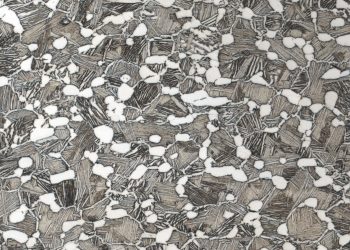
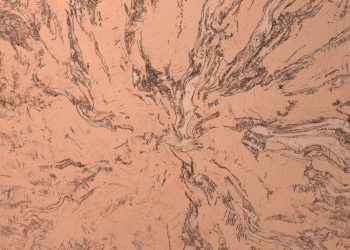
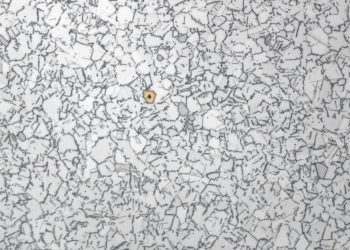
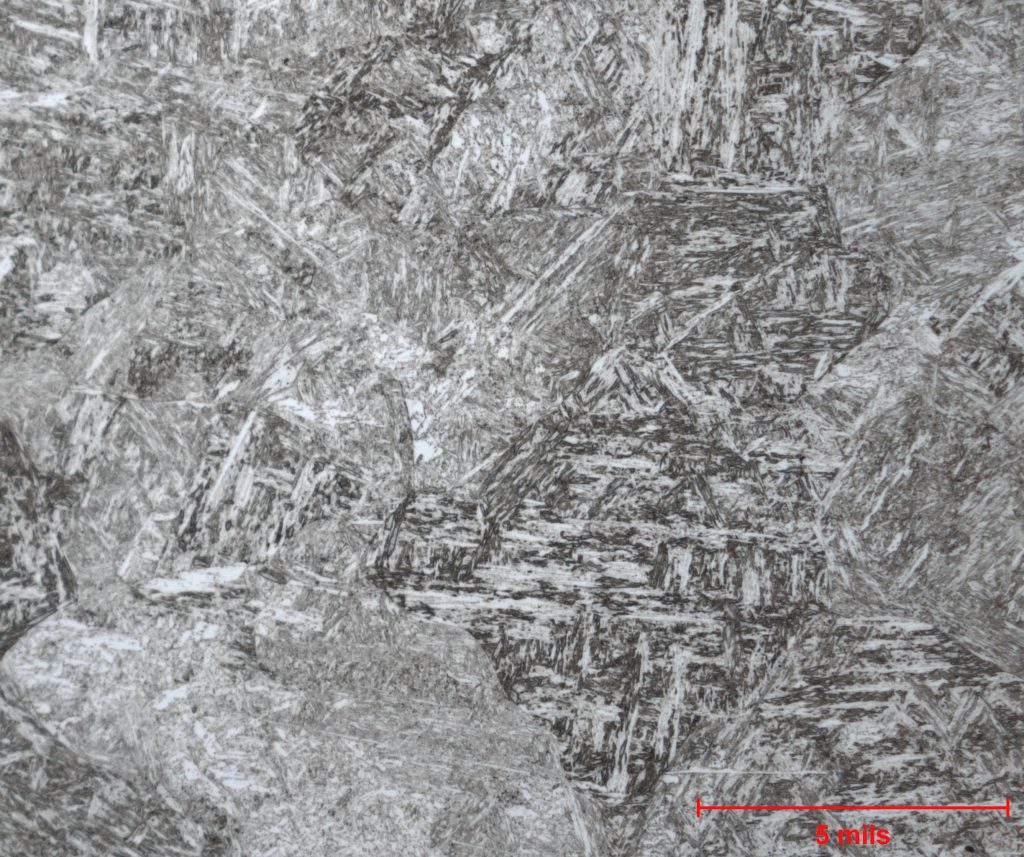
Below are three photomicrographs of 410 martensitic stainless steel at three different magnifications (100X, 200X, and 500X). The sample was prepared from a piece of 410 bar stock which was ground and polished to a sub-micron final polish. Then the sample was etched using Vilella’s Reagent. The sample microstructure consists of tempered martensite with some retained austinite and carbides.
Vilella’s Reagent:
1 g picric acid, 100 mL ethanol, 5 mL hydrochloric acid