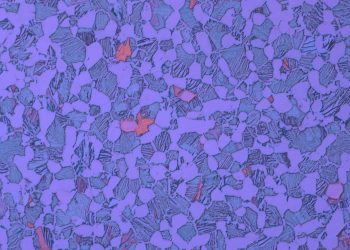
So this post be a bit outside the typical scope of this blog being that it’s not technically metallography. Silicon carbide is a semiconductor which takes the form of hard grains that are often used to manufacture abrasives. These grains can be sintered together to form very hard ceramics that can be used to make parts such as car brakes or clutches. I recently received a large silicon carbide sintered part which I managed to prepare and etch with better results than any of the reference material that I could find. The sample was ground using diamond grinding discs for about 2 minutes through each of the following abrasive particles sizes: 80 grit, 120 grit, 180 grit, 240 grit, 400 grit, 600 grit, 800 grit, 1200 grit (30N force per sample). Then course polishing was performed using a 9 micron diamond suspension using a Struers Allegro and Largo diamond pad (30N force per sample for 8 minutes each). Fine polishing was accomplished using Struers Dac pads with 3 and 1 micron diamond suspension (30N force per sample for 5 minutes each). The final polish was achieved using a Struers OP-Chem pad and a cerium oxide suspension (30N force per sample for 2 minutes). Afterwards, the sample was etched using an boiling Murakami’s etch and electrolytic etch as detailed below.
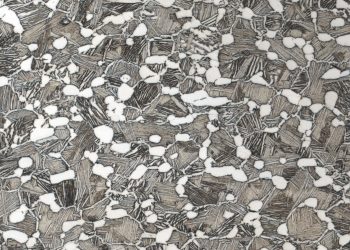
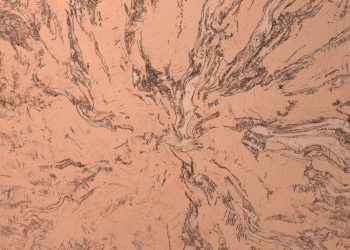
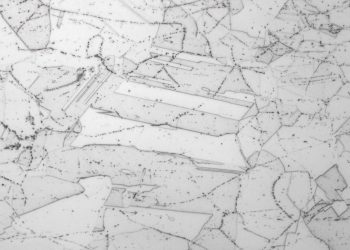
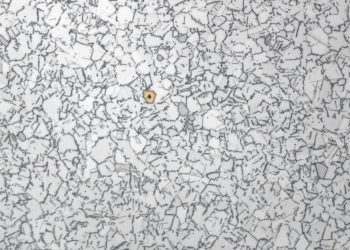
In the photomicrographs below, the sample microstructure can be seen which is a mixture of twinned large and small grains. The first set of photomicrographs is etched using a boiling Modified Murakami’s Reagent for approximately 40 minutes until the structure was revealed. The second set of photomicrographs is etched using a electrolytic tint etch (NNC103) for a total of 6 seconds at 6 volts.
Modified Murakami’s:
240 mL Water, 30 grams Potassium Ferricyanide, 30 grams Potassium Hydroxide
NN103:
50 mL Acetic Acid, 15 grams Chromium Trioxide, 48 mL Water, 4 mL Sulfuric Acid, 1 mL Ethanol