Alpha-beta
titanium alloys are commonly used in aerospace applications where high strength
and low weight are key performance drivers. Alpha beta titanium alloys are
capable of matching the strength of high strength steels while having nearly
half the mass. However, titanium alloys can have very different structures
depending on the thermos-mechanical processing history it undergoes.
I
had ordered a large piece of titanium bar stock for making a stress-corrosion
cracking test fixture. With some of the leftover material, I made a mount to
see the microstructure of the Ti-6Al-4V I had ordered from McMaster-Carr.
I
took the material and hot mounted a transverse cross section. I subsequently ground
until it was plane and fine ground the sample to 400 grit. Then, a Struers MD
Allegro Pad using 9 micron diamond suspension was used to plane the sample for
about 5 minutes using 30N of force per sample. Afterwards, a Struers MD Largo
Pad using 9 micron diamond suspension was used to polish the sample for about 10
minutes (30N per sample). Afterwards, a Struers OP-Chem Pad was used with a colloidal
silica suspension and chemical addition to mechanically and chemically polish
the surface for 3.5 minutes (30N per sample). Then the sample was etched using
Kroll’s Reagent.
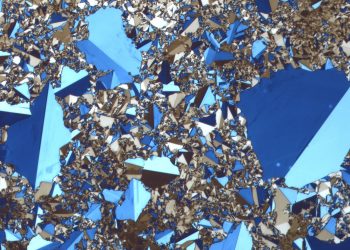
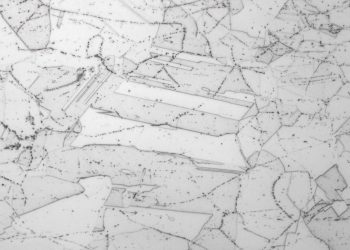
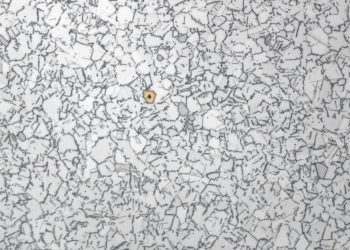
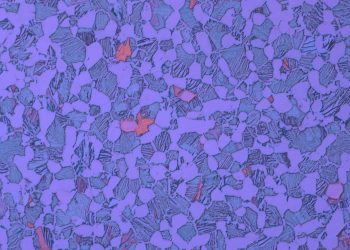
The below
photomicrographs show the sample microstructure at magnifications of 100X and
200X. The sample microstructure consists of equiaxed primary alpha in a matrix
of transformed beta containing fine acicular alpha.
Chemical
Polish:
150
mL Colloidal Silica, 15 mL Ammonium Hydroxide, 5 mL Hydrogen Peroxide (30%
concentration)
Kroll’s
Reagent:
3
mL Hydrofluoric Acid, 6 mL Nitric Acid, 91 mL Water